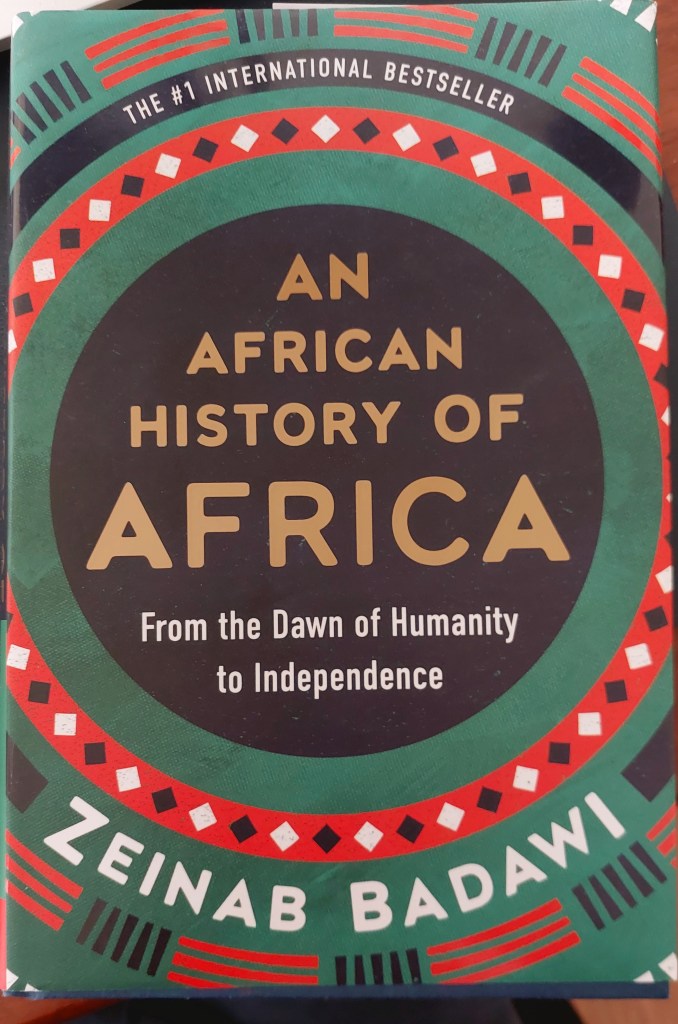
Over late December and most of January, I took the time to read a book that had gathered dust on my shelf for much of 2025. Originally published in 2024, it was historian and broadcaster Zeinab Badawi’s An African History of Africa: From the Dawn of Humanity to Independence. I had purchased the thick tome in the winter of 2025 and, as is often the case when bolstering one’s library because one plans to “definitely read the book soon,” “soon” morphed into about 9 or 10 months later.
Why bother with this book? What about it drove me inexorably towards a purchase with hard-earned money? Truth be told, I was, at best, vaguely aware of British-Sudanese author Zeinab Badawi prior to picking up a copy of her work. And I’m being rather liberal with the term “vaguely.” She did something in academia, but what exactly, I would have been hard-pressed to say. As it turns out, she’s vastly more accomplished than I would have assumed. To that point, An African History of Africa is, to an extent, a book form of a running BBC documentary series about the continent’s past.
What Do I Know About Africa?
Frankly, not a ton. And, if we are to be perfectly honest, unless you genuinely, sincerely have studied its history, read up on it, or regularly read news and analysis from the continent, neither do you. And there is no shame in admitting it. None whatsoever. I live in Montreal, Canada. Yes, there are many people of African descent in Canada, but it’s not a continent one hears about regularly.
Take a glance at the homepages of CBC News, La Presse, DW, BBC News, CTV News, or Al Jazeera. Some feature no news out of Africa at all. Others, precious little. Al Jazeera earns the best mark, although that is partly because of the relative proximity of its headquarters to the continent (Doha, Qatar). Even so, it isn’t as if most of the headlines pertain to African happenings.
And yes, in a matter of a few clicks, a visitor can land on a news page featuring either more of or exclusively news about Africa for each of the aforementioned news outlets. It takes about 5 seconds. The point here isn’t so much that there isn’t anything about Africa to read, but more so that very little emphasis is placed on the subject. As an old expression goes: Out of sight, out of mind.
If pressed further, the layperson will mention that they are aware of the African slave trade. Fair enough. A few will be able to utter the word ‘’Apartheid.’’ Well done. The name Nelson Mandela should ring a bell to a few. In fairness, awareness of those elements is better than complete obliviousness, but readers can guess where I’m going with this.
The Beauty of Ignorance
This is going to sound painfully obvious, so much so that eye rolls will be forgiven, but, at its core, the history of Africa is indeed the world’s history. Zeinab Badawi herself makes the point in the book’s introduction. Migration through the ages is why there are humans in practically every spot on Earth, but originally, our collective and biological evolution spent most of its early phases on African soil.
Perhaps it is the wannabe journalist in me. Sometimes I cannot help myself – although I’m not convinced there is a good reason to try to help myself. Knowing things is fun. The euphoria, the release of dopamine when a new tidbit of knowledge enters the mind, those are things I live for, at least partially. The mere fact that I don’t know much about Nigeria, Cameroon, Senegal, Mozambique, Zimbabwe, Ghana, Côte d’Ivoire, the Democratic Republic of Congo, Ethiopia, Sudan, or Algeria is itself exciting.
Not knowing, the admission of such, and the humility in admitting it, are some of the greatest intellectual, emotional, and maybe spiritual powers humans can possess. By that, I don’t mean it’s okay to waddle or bathe in one’s ignorance. Rather, ignorance is the platform by which we venture onward to acquire new knowledge.
Badawi’s Big Tent Approach
Enter An African History for Africa. At the risk of oversimplifying the author’s strategy, she takes a ‘’big tent’’ approach. The book is 532 pages long and, spoilers, the sources, notes, and index commence at page 465.
How does one fit literal millennia of human evolution and civilizations – from politics, religions, culture, economies, and architecture – in 465 pages? Not every personage of significance can be discussed, and some are given just a few paragraphs for elaboration. In Badawi’s defence, she alludes more than once to UNESCO’s titanic endeavour: General History of Africa (GHA). If readers want to spend (rewarding) weeks, if not months, in the history of all things African, that’s the top source.
Badawi’s prose is simple and efficient. Neither a lack of familiarity with the continent (isn’t that why one would read the book?) nor intimidation of challenging, academic jargon should discourage potential readers. It is a marvellously easy and inviting book to enjoy. Further enhancing the project is the second aspect of the journalist-historian’s approach: her sources. Apart from UNESCO’s GHA, Badawi spent years on the ground, interviewing local archeologists, academics, writers, community leaders, and current and former political participants. Hence the oeuvre’s title. This is not only a history of the continent. Its contents come from the horse’s mouth.
Before reading An African History of Africa, I was unaware of the Benin Bronzes, Tippu Tip, the Kingdom of Kush, Queen Kahina, Queen Nzinga, or the written work of former slave Ottobah Cugoana. To be clear, I have not become an expert on any of those topics. Far from it, in fact. Nevertheless, I’m aware of their existence, something I was not just a couple of months ago. Should I choose to venture deeper into them, or any other subject broached in Badawi’s book, I now have a reference platform. A starting point, if you will.
To be curious and excited about the world is a wonderful habit to pick up. Part of the word “history” is “story.” By golly, there are stories aplenty to be shared about Africa’s distant and not-so-distant past.
 Edgar Chaps
Leave a comment