I recently arrived at a realization. It happened perhaps a year ago. I was using public transportation to head into town. A few years ago, my neighbourhood – along with a few others – was blessed with the arrival of a swanky new above-street-level train. It doesn’t always work, especially in the winter, but that’s another story for another day. In any case, it struck me in that moment as I lifted my eyes away from my mobile phone’s screen, that literally everyone around me was doing the same.
Not in the sense that we all tilted our necks upwards and noticed each other at once. It was the fact that every passenger was either reading, watching, or scrolling through material on their phones. It wasn’t the first time I noticed such a reality. Far from it. Nevertheless, it hit me harder on that occasion. The synapses sparked in my mind, with images of me wasting my time on social media in the past few years. Additionally, I recollected articles I had read about the possible effects of scrolling, and our collective dependence on our shiny phones for just about everything these days. All of this came to a head. My head.
I had to find ways to hold onto what was left of myself.
Lose yourself (not the Eminem song)
At the risk of sounding painfully obvious, this is a very personal article. It’s my personal site, so why wouldn’t it be? I’m only prefacing what’s to come with that notion because, well, some people are rather touchy when they read or hear something that ever so gently questions something they take to heart (a habit, a preference, a belief). I’m not here to question what you do. As the kids say these days: you do you, boo.
I’m quite literally saying the opposite: I questioned myself. Some of the habits I’d prefer shunning persist. When watching a film at home, I’ll still sometimes glance at my phone. I also won’t pretend that I never read anything on my smartphone when taking public transportation.
All that said, I clued in on the fact that I had lost a part of myself. I was such an avid reader when I was younger. Novels, especially, but I’d dabble in other material as well. I loved writing. I had even spent a couple of years in the not-too-distant past earning a living by writing about sports. I loved knowing how to search for information. For crying out loud, I went to university twice for courses in subjects that required more reading and writing, less number crunching. I had a curiosity about things: places, people, cultures, languages, art forms.
I realized that I was losing that to an extent. I had a Twitter account, a Facebook account, an Instagram account, a Bluesky account, a TikTok account, a Letterboxd account (to log films), a Goodreads account (to log books), a YouTube account, and a LinkedIn account. I wasn’t reading anymore. I was mostly watching sports (which is fine, I love sports, but it was gobbling up more of my time than I cared for). I chatted for hours on end on Messenger. Messenger is fine. It can be useful, but I was chatting a lot.
Tech: can’t live with it, can’t live without it
What tilted the scale in favour of returning to an echo of my former self was the advent of programs like ChatGPT and the bountiful uses of AI, or generative Artificial Intelligence.
Let me be perfectly clear. ChatGPT and the like are very, very clever products. The people who came up with those tools are smart and worked hard to make them a reality. I applaud the gumption and novel thinking that spurred their development. But when one lands on articles such as this one from The Quantum Record, which essentially recaps a series of other studies about our relationship with such tools and how they are affecting our cognitive aptitude, anyone with a decent head on their shoulders should at least ask themselves some questions. If we have so many tools at our disposal to learn, stay informed, and broaden our minds, it’s odd that, on average, our IQs have been lowering for a good number of years (the anti-Flynn effect)
I went down a bit of a rabbit hole via the aforementioned article and spent a brief spell on the Harvard Medical School website reading about doomscrolling. That was revelatory because it’s certainly something I’m guilty of. Scrolling and quickly reading a never-ending and perpetually updated list of negative news stories, courtesy of various news outlets. The “fight or flight” part of our brain and the rush in produces is, partially, what gets us to continue scrolling and read more negativity. Fascinating stuff.
Then there is this interesting piece from the Mayo Clinic Press about a term I had never come across before: popcorn brain. It sounds like a joke, but it seems as though, while it is not clinically recognized, it is a bandied term referring to someone’s electronic multitasking. Jumping from one video to the next, two videos at once, then a tweet, then an Instagram like, then an email, then back to the videos…Compared to all that relative excitement, the real world moves at a much more languid, boring pace. No wonder everyone on the train is staring at their phones
Finding myself…sort of
It would be a stretch – and somewhat melodramatic – to claim that I’ve “found myself.” However, I have taken small actions. Subtle gestures for my own sanity, to rekindle the kind of normally functioning person I was years ago.
Twitter, Bluesky, and TikTok are things of the past as far as I’m concerned. I’ll post the odd picture on Instagram, which automatically updates my Facebook page, but that’s about it. A week or two can go by without me posting anything, though.
I’ve gone back to reading books. Mostly for pleasure, sometimes to learn. It’s gotten to the point where I practically want to nod my head in salute to anyone I spot on the train with a book in their hands. I shouldn’t disrupt the flow of whatever chapter they’re engaged with.
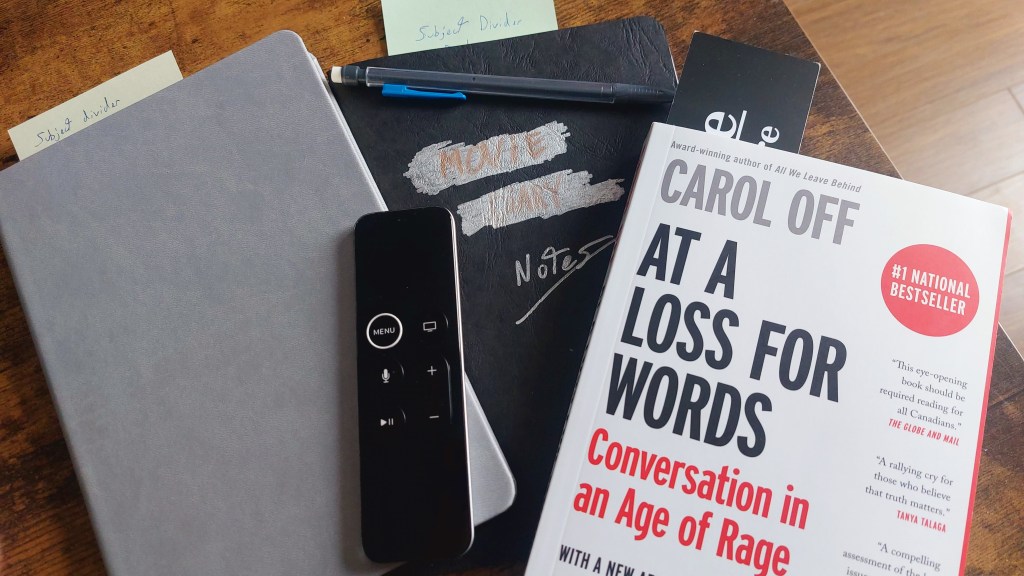
I don’t log anything on Letterboxd anymore. I have a journal. Yes, a journal. Pen and paper. That’s not quite accurate. Lead and paper. I like knowing I can erase a silly mistake rather than produce an ugly strikeout over it. At the time of writing, I still log my books on Goodreads, but I can see that ending soon.
When searching on Google, I don’t read the AI response, which is, of course, the first result at the top of the results page. I look down for something with more heft, such as an encyclopedia, something scholarly, or anything with an ounce of decent repute (news article, respected blog, podcast, etc.).
I don’t use ChatGPT. I can understand why others do (remember: you do you). It’s practical and, to an extent, it looks fun. Say a little sentence into your phone’s mic (or type it), and a computer program generates an answer. It’s clever. But I know myself. I can do the research. And please, by “research,” we’re talking about two, three, or four minutes of reading a few Google search results. A practice – I feel the need to point out – that allows one to cross-reference info at the same time. Do people cross-reference information that ChatGPT generates? Do they?
I don’t speak into my Apple TV controller anymore. I type my YouTube and streaming platform searches. Is it Wong Kar-Wai, Wong-Kar Wai, or Wong Kar Wai? Ousmane Sembène or Ousman Sambène? It takes 30 seconds to figure it out, then type it. Trust me, it doesn’t hurt.
Nobody needs to do the things I’ve opted for. To each their own. Just know that if you ever suffer a moment of depression or embarrassment the likes of which I did on that day, you are not alone. It’s okay to feel like that. It only means that there is a part of you that wants to continue existing somewhat outside the digital-AI-ChatGPT space.
As a society, we will march onwards with those tools at our disposal. We will all, at least occasionally, use them. No exceptions, not even me. But clinging to the simple things that make us human, like (very) basic cognitive skills, is important.
I choose to cling.
 Edgar Chaps
Leave a comment