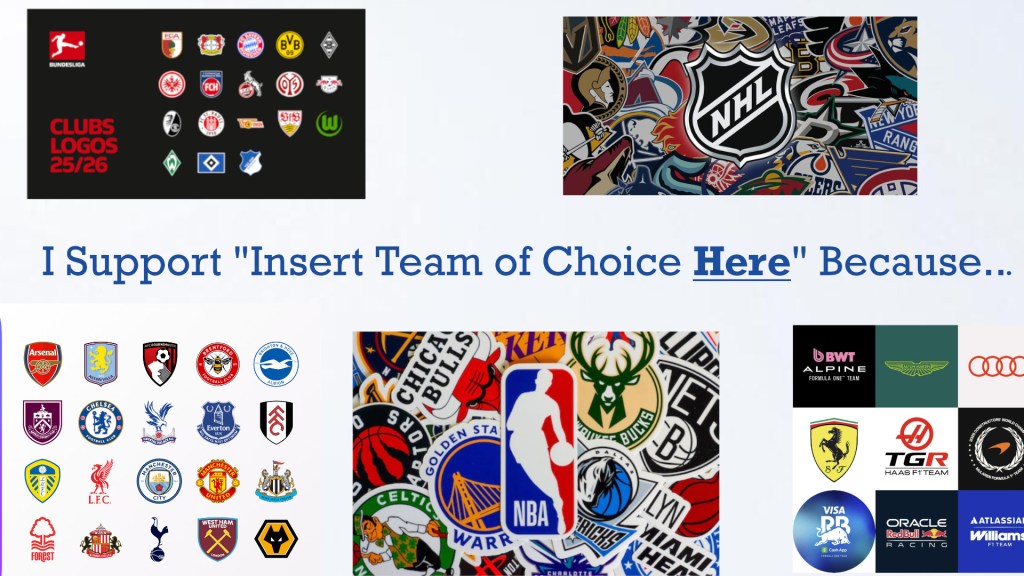
One of the more peculiar hobbies humans have is supporting professional sports clubs. What are pro sports teams (or individual athletes) to us? Their success or failures are not our personal successes or failures. Nor do they contribute to enhancing our pocketbooks. If anything, depending on the degree of one’s loyalty, teams extract a lot of money from fans! It begs the question: why?
Following Sports Themselves
Obviously, if one is to adopt a particular club or athlete to cheer on, there must be some level of interest in that sport. Why even bother following sports? Writing personally, it’s a form of relaxation. A form of escapism, if you will. After a long day at work, or a hectic week, or when I’m feeling down, I’ve noticed that sitting back and enjoying a match of some sort – almost regardless of the field – makes me feel okay.
Notwithstanding the rules dictating how games are managed, sports are relatively simple. It typically comes down to scoring more points than the opposition. Alternatively, if motor sports are your cup of tea, it’s about finishing ahead of the pack. As such, they’re not especially complicated. Understanding how athletes or teams net points can be overwhelming (American football comes to mind), but that’s another matter for another time.
Appreciating the physical feats done by the competitors captures the imagination. The years they’ve spent training to compete in their chosen field, and to do so at such high levels against their peers, is wondrous. Someone will win, and someone will lose, but in competitions such as the NBA, NHL, or UEFA Champions League, everyone involved represents the best and brightest.
Classic Reasons
As for the reason someone elects to support a specific club, two popular explanations come to mind. The first is that the franchise represents a locality where the person lives, grew up, or spent a significant portion of their life. Grow up and support Toronto and Torontonian clubs. A Vancouverite will get behind Vancouver-based teams, and so on.
Simple enough. After all, most people have a sense of admiration and pride for their nearest communities. When a large group is excited for a key match involving the local side, there is a swell of community emotion. Many people enjoy being a part of that. Win together, lose together, but most importantly, stick together.
Alternatively, the parents might influence where one’s proclivity gravitates. This can be especially true for sports not represented at all or significantly in a city. I know a friend who is a big Manchester United supporter. He doesn’t live there, nor is he Mancunian or English. His father, however, also appreciated the club, and there you have it.
Alternative Reasons
This is where things can get intriguing. There are several other equally valid, if less obvious, factors that determine why one would fly the flag of a given team.
A Reference Point
First, by selecting a club, the fan has their reference point in the sport. Is the team good this season? How are they performing in relation to the opposition? Who are the main rivals?
By focusing on a specific ensemble, it can be easier to comprehend a season, even a league, as a whole. We tend to compare things a lot anyway, either out of habit or, much like with sports, to better process information.
This can be especially helpful for competitions that are more difficult to follow or for which one doesn’t have the necessary leisure time to devote their full attention.
Storytelling
“Storytelling” is somewhat of a vague term. Nonetheless, every team, however successful or not, has a story to tell. The story of its origins, those of the players, coaches and managers who have come and gone. The stories of memorable nights and campaigns. The stories of…ignominious occasions.
There are stories within stories. A given player suited up during several seasons for a club. They put up certain numbers and so on. But who was that individual? Where did they come from? What was their journey that led them to the team? Was it at the start of their professional career, in the middle, or towards the end? What was their relationship with their teammates, their coaches, the fans, and the city?
There are stories within stories within still other stories. A team has lost three games in a row. Who is injured? What is the mood during morning practice? How are coaches and players keeping a positive attitude? Why did it look as tough a pair of teammates were jawing at each other when the group fell yet again for the fourth consecutive time?
A team is a drama television or streaming show that consistently delivers.
The Beauty of Collectivism
Earlier in this article, I alluded to supporters sticking together. Of course, the same goes for a given side. But unlike major international tournaments, where “sticking together” is, let’s say, easier insofar as players, coaches, and fans are from the same nation, when it comes to a club, it’s a much more delicate balance.
Players aren’t from the same city, have the same mother tongues, or hail from the same country. Some were born halfway across the globe. And yet, they must come together to attain a degree of success.
A football club in Germany, led by a Spanish coach, with athletic trainers from England, France, and Argentina, and players from a dozen different nations across several continents, must find a way to come together as a unit. Whether they win or lose, it has to be together. And they have to do so in a German context. Perhaps in a small German town such as Sinsheim, or a metropolis like Berlin.
This complexity, which, in the best of times, translates to collectivism, is one of the most fascinating aspects about sports teams.
Quirks and Quarks
Some people decide on their team of preference for altogether more curious reasons. Club colours, crest, a city they love but don’t even live in or originate from. A game they watched with family or friends, discovering the league for the first time, and something about one of the rivals caught their attention: a player, the look of the stadium, or any other quirk that strikes their fancy.
In some instances – I can speak to this – it is the birth of a new franchise. The design team comes up with a clever, inspiring, unique, or amusing name and logo, and it’s off to the races. That example’s quality lies in the fact that one gets to see a club’s evolution from its inception. They were there when it all began.
Whatever the reason for one’s choice, it is the correct one. Opting to support a given team is not a mathematics-based science. It’s a feeling.
Ultimately, do what feels right, regardless of what others believe.


Leave a Reply