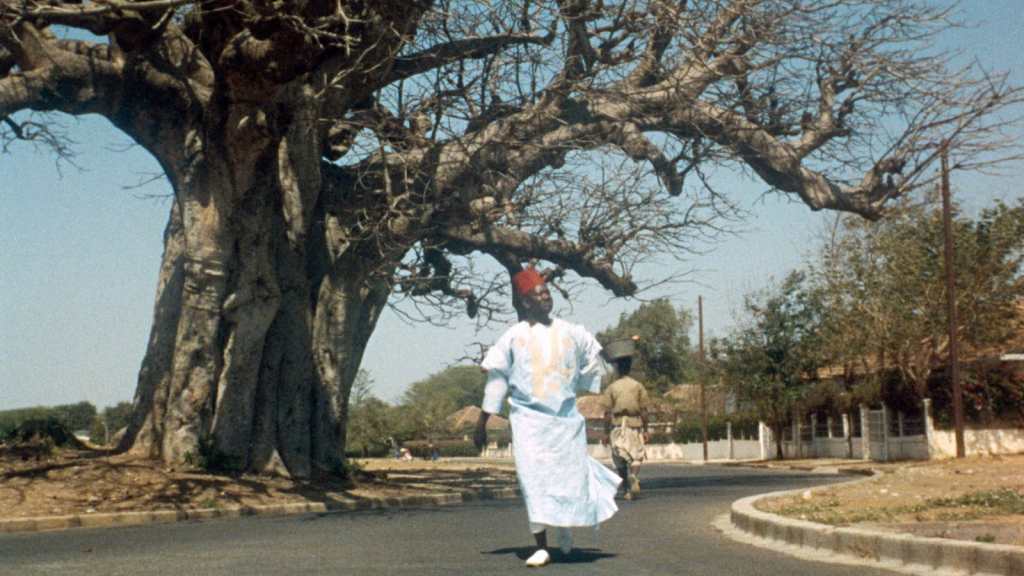
Earlier this year, I shared some thoughts on what it has been like to discover cinema from the African continent. The journey was well worth it, and although it is far from over, I had an itch to revisit some works by a filmmaker whose efforts struck a chord: Ousmane Sembène, Senegalese. This past week I enjoyed Mandabi (1968), Emitaï (1971), and Xala (1975), and a thematic trend emerged: Everybody has problems, and they all fit somewhere in a hierarchy.
Sembène the Cinematic Pugilist
In one of the supplements featured on the Criterion Channel with film scholars and historians, one interviewee distills Sembène’s lens as that of a world in opposition. It’s easy to understand why. Born in 1923, the author-filmmaker spent his childhood and early adulthood in an era when his native land was still under colonial rule, in this case, France.
Given the country’s eventual independence in 1960 (Sembène was 37 by then), he spent much of his life when there was consistent opposition of a political nature between two sides. He was also a staunch communist. One example is his experience as a dock worker in Marseilles, which led him to participate in union activities. In an age when the two global opposing forces were Western capitalism and Soviet communism, this too would surely influence the Senegalese’s outlook on how the world worked.
Speaking of the Soviet Union, Sembène’s cinematic education was in part completed in Moscow at the Gorky Film Studio. Talk about a way to integrate oneself not only into a form of artistic expression but into an economic and political philosophy as well.
Mandabi: Fighting Red Tape
Not all of the filmmaker’s oeuvre is available at the Criterion Channel, but a significant chunk is. Mandabi, from 1968, holds a special place in cinematic history, especially African. It was the first motion picture filmed in Wolof, which is the main local tongue in Senegal (there are over 30 dialects spoken in the West African nation). Up until then, most movies were recorded in French.
The plot follows the trials and tribulations of one Ibrahim Dieng (Makhouredia Gueye), father of many children and, well, husband to several wives, as goes the local tradition. Set in the capital city of Dakar, it is a few years into the post-liberation era. A jobless Ibrahim receives some positive news from a nephew working in Paris: a money order for 25,000 francs. All he needs to do is cash it.
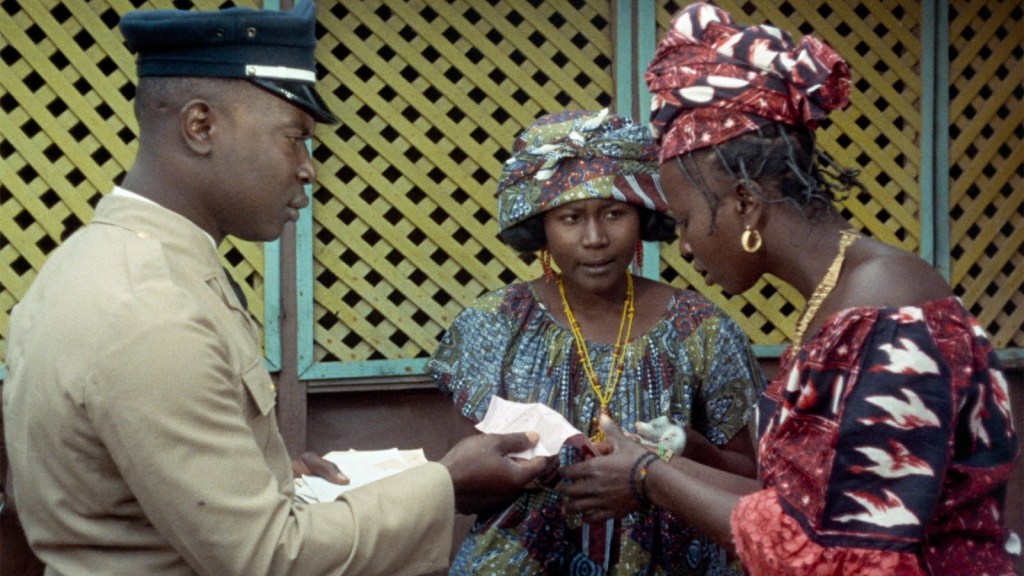
There are some caveats, however. First, only a small portion is, in fact, intended for him. The nephew wishes most of the cash to go to his mother. That, of course, doesn’t stop everyone around Ibrahim from asking for a handout. There is also the small matter that he has no identification. To get an ID, he needs to traverse the madness that is the bureaucratic system that reigns in this brave new world.
Mandabi is a comedy of errors, of Murphy’s law, and of the tug of war that happens when old traditions clash with a modern world, albeit circa the late 1960s. For instance, Ibrahim wrestles with what his wives do without his knowing. Their actions are mostly in the family’s interest, but that doesn’t fly with the “man of the household.”
Rather than present Ibrahim as a villain, which would be the facile route in a modern movie, the picture offers a comically nuanced depiction of the central figure’s reality. He is illiterate (which may or may not be his fault; it’s never explained), hopes to land a job to support his immediate family, is bull-headed in some respects, yet also charmingly naïve insofar as he adheres to strong principles of honour, authenticity, and dignity.
In essence, he is a person slightly out of time. Antiquated in some respects, laudable in others. Maybe a few years ago his methods and lifestyle meshed more effortlessly with Dakar’s rhythms, but no longer. He is cheated by a photographer who supposedly takes pictures for passports, is given the bureaucratic roundabout several times, and witnesses clerks openly complain about how miserable their lives are at work (again, Ibrahim would love some employment right about now).
What is a man to do when their sense of right and wrong is suddenly anachronistic with a society that has taken a hard shift in another direction? Not only is their fighting amongst those mentally equipped for the dog-eat-dog world, but Ibrahim doesn’t even know his dog’s race is reaching extinction.
Emitaï: Grassroots Struggle and Battling the Gods
Next was Sembène’s followup, Emitaï, a story that marries harsh truths about World War II with religious-fantasy elements.
No one would argue that France was the outright villain in WWII (the Nazis seemed more than pleased to take on that role); the fact of the matter is that all is fair in love and war. To that point, when France fell to the Third Reich, the desperate times called for desperate measures. The France Libre resistance movement/government needed men for combat, not to mention sustenance to keep the troops fed. That the war doesn’t really concern the locals at all is, “naturally,” completely beside the point.
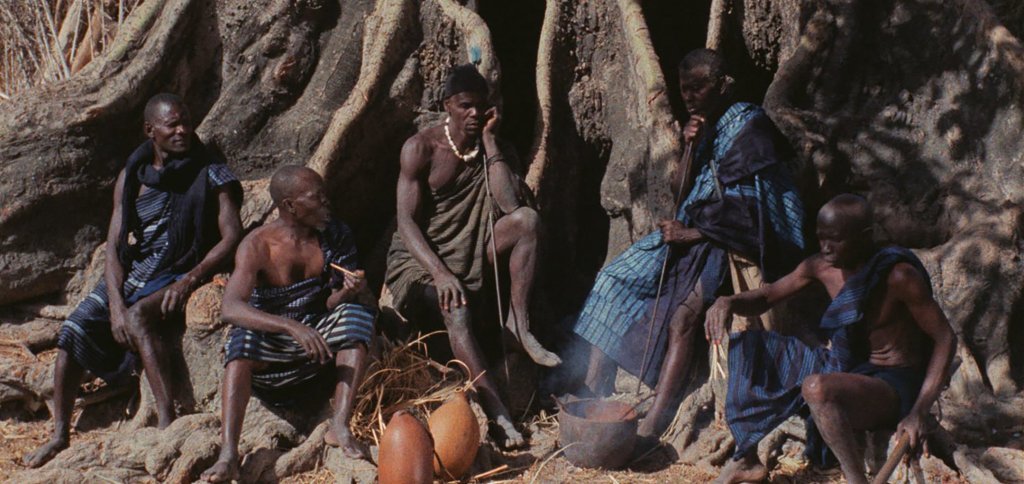
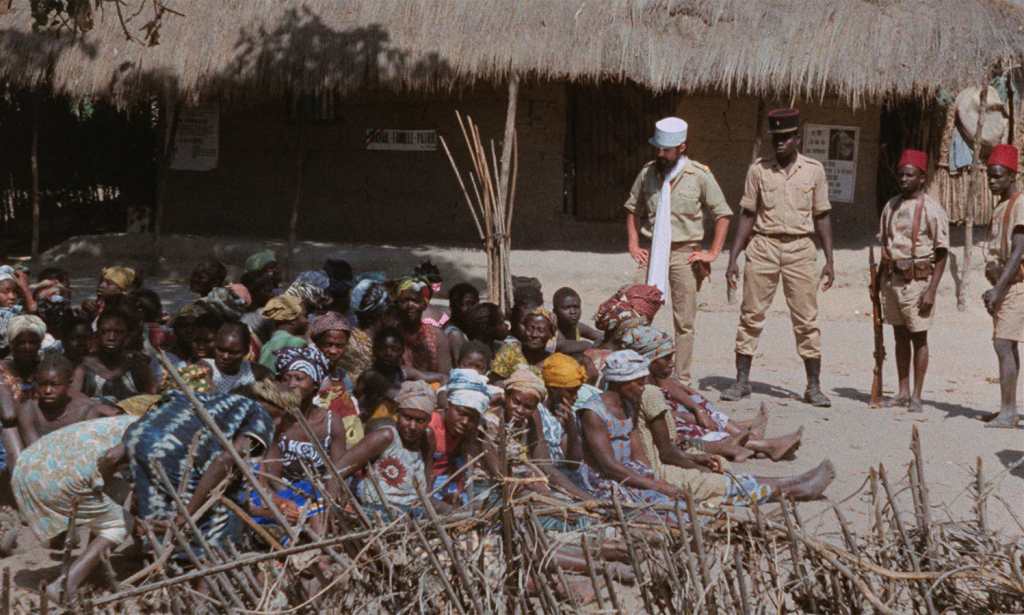
Enter the Diola (or Jola), a small community that adheres to traditional religious practices and is a key rice cultivator. The men are forced into the army, and a village is under threat from the local French authorities: give the resistance its needed supplies – most notably rice – or there will be hell to pay.
Women and children are thus taken for a ransom of sorts, placed under the sun all day long. French forces (and the already integrated Senegalese soldiers) search for highly coveted supplies which the village keeps hidden. Meanwhile, a small group of elders debate about what their community’s next move should be. Give in to the French? Keep causing them headaches? Take up arms against fellow Senegalese who appear to happily comply with their European superiors?
Maybe speaking to the gods, among them Emitaï – the deity of thunder – will provide the answer.
This 1971 effort is fraught with problems mere mortals must face, many of which take different hierarchical guises. For one, there is the grassroots resistance performed by the village women. At no point are they dissuaded from holding their silence about the whereabouts of the prized rice. Fatigued, hungry, thirsty, and insulted by the French guarding them, they remain resolute. It’s like an unintended hunger strike. That wasn’t the plan, but now the French are clearly caught off guard by how the circumstances have shifted.
On a second, arguably more removed level, are the scenes involving the elders who pray to the gods for guidance. The film never depicts them mingling with the other village denizens. They seem to exist slightly apart from the reality of the situation. They are keenly aware of it and its gravity, hence why they have convened. Even so, their relationship to the challenge at hand is more of the intellectual, existential, and spiritual varieties. The commoners will do what they have to do, as will the elders, even though it feels as though their paths rarely, if ever, actually cross.
In a scene that must have been quite something to witness in 1971, it turns out the gods aren’t much keen on discussing the potential extinction of those who venerate them. What matters is the veneration itself. Now, where are our sacrifices?!?
We all have our problems.
Xala: A Crooked Life Gets Hard
Finally, I watched Xala for the second time since summer 2025. It is, from a certain point of view, a sex comedy. Except it lacks sex. In fact, it’s more about a character’s sex problem.
Say hello to El Hadj Abdoukader Beye (Thierno Leye), or simply El Hadj, a Dakar-based businessman who imports goods from Europe to sell locally. A marriage looms, his third, for that matter. Despite him growing older with time, each virgin wife is always taken at a wonderful, ripe age. The first two don’t exactly get along, with the second, Oumi Ndoye (Younouss Seye), laying it thick about what a spineless coward he is. But as long as he gives her allowance, she’ll stick around.
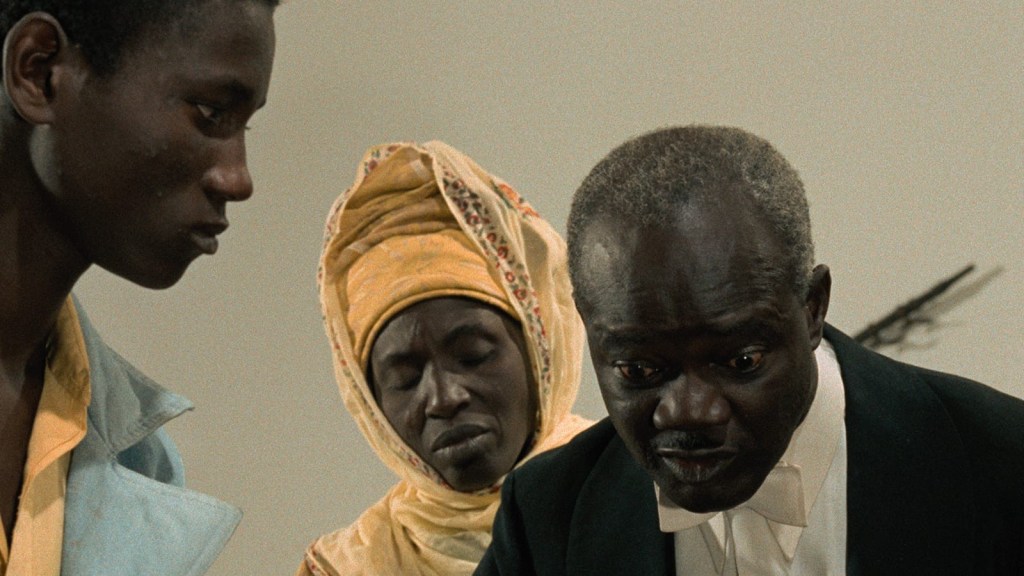
The celebrations are grand, and everyone appears chuffed. And that’s about the stage at which the good times come to a crashing end. El Hadj, fine adept of European customs that he is, scoffs at his third mother-in-law’s request that he partake in a local custom before the knot is tied. Strip pants off and waggle a stick like it’s one’s ding-a-ling? The very thought!
Big mistake.
That same night, as the newlyweds are given their privacy, El Hadj can’t perform. Somehow, he is a victim of a xala hex. Basically, he can’t get it up. Desperate, he seeks a cure by opting in to traditional religious practices so that he, or rather, it, may rise again.
Early in the picture, viewers are provided with some key facts. First, French authorities have recently been ousted, thus liberating Senegal. On the flip side, the new government, with whom El Hadj is closely associated, are all paid off by their former rulers. Governing the people in need requires funding, does it not? In this instance, said budget pertains to personal wealth, but what the public doesn’t know can’t hurt them.
Of the three pictures discussed, Xala is the most multilayered. One can also argue that it is the most “on the nose” of the trio. Sembène juggles several characters. Moreover, the director juggles several groups of characters. El Hadj, his immediate family (the relationship with a teenage daughter from his first wife is strained), the government officials, and Dakar’s destitute.
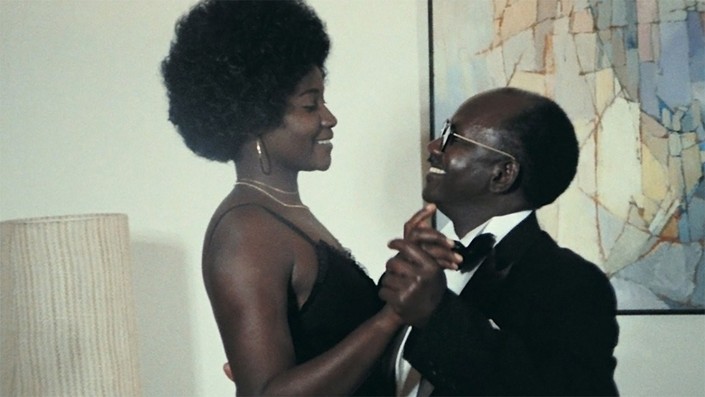
Even at two hours, Xala has a lot on its mind, from another expose on the clash between modernity and tradition, the corruption rife in a newly formed, post-colonial governing body, to how those living in the streets are taken care of. Or not taken care of, rather. Because of that, the picture must get to the point and not dilly-dally with subtlety. It’s a way of getting ideas across, one that Sembène embraces. As previously discussed, he was politically active and knew where he stood on the spectrum.
Unlike in Mandabi, where the viewer can feel empathy for a flawed protagonist, such is not the case in Xala. El Hadj is overjoyed with his comfy lifestyle and, as far as he is concerned, there is no question of going back. Maybe we can roll with his adherence to polygamy because a non-Senegalese or African audience would want to let the reality of this world breathe. But when he calls in the police to rid the street of “human trash,” disrupting his business, the figurative gloves are off between us and the central figure. Wet noodle issues? Too bad.
In that sense, there are not only struggles between El Hadj and his personal plight, corruption and the citizens, and multiple wives, but a fourth-wall struggle between El Hadj and the viewer.
Revisiting Old, Flawed Friends
There is no doubt that Sembène has quickly become one of my favourite filmmakers. I hadn’t even heard of him about 15 months ago at the time of writing. Five feature-length films and three shorts later, he is up there with Ridley Scott, Akira Kurosawa, and Anthony Mann. After all, a little over a year later, I’m already revisiting flawed friends like El Hadj and Ibrahim.
There are tons of ways conflicts can be depicted on screen. It depends on what kind of conflict and how the storytellers want to approach it. Sembène was aware of the challenges his native land faced historically and was still facing when he made a career in film. Heh opted to pepper dire situations with comedy. There are no belly laughs and maybe no knee-slapping scenes, but one can tell the director understands how, if the angle is tilted askew by an inch, there is silliness in nearly every conflict.


Leave a comment