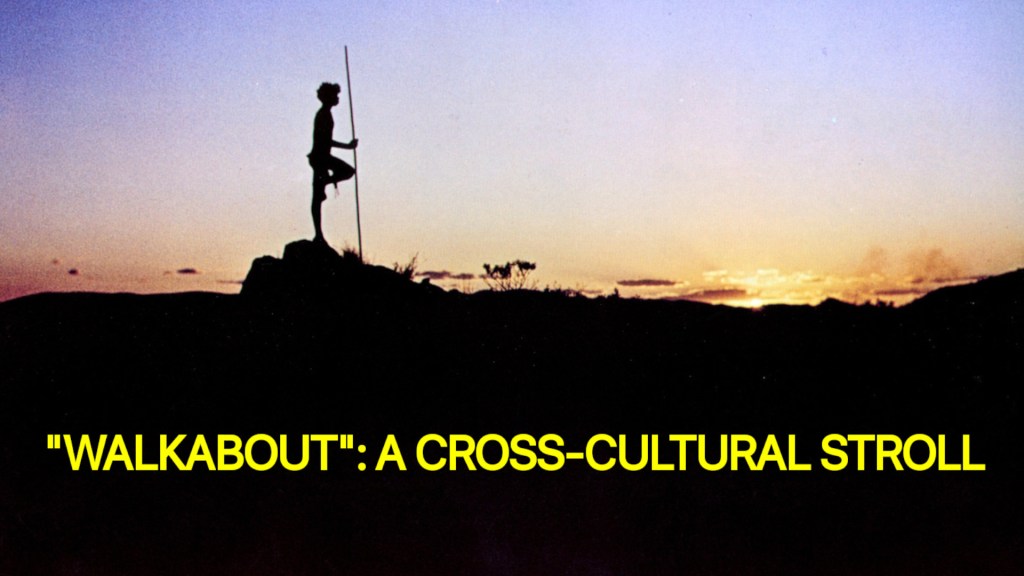
I give myself a cinephile mission every week. This has been going on for a couple of months now. In essence, I pick a film that I either know only very little about or nothing at all. No trailer, hardly any images, and perhaps only a glance at a synopsis. Furthermore, I’ve tried to make it so that it isn’t such an obvious choice (i.e. a blockbuster that came out a few months prior). Most of the quasi-random selections have proven worthwhile. Martin Scorsese’s After Hours, Luis Bunuel’s Viridiana, Humberto Solas’ Lucia, all moderate to strong successes. Then came Walkabout from 1971.
Brits Lost in the Outback
Walkabout is a title I had heard of. Little of the plot was known to me. In fact, the most that I was aware of was its iconic status in the history of Australian cinema.
One of several ironies I learned upon watching the film and subsequently reading about its production is that it’s director, Nicolas Roeg, was English. The film’s protagonists, a teenage girl (Jenny Agutter) and young boy (Luc Roeg) are also English. That it is revered as an Aussie flick is mostly because its story takes place and was shot in the country. Furthermore, and this next point is critical, the only Australian character viewers spend significant time with is an Indigenous teenage boy, played by David Gulpilil. The latter would move on to an impressive and expansive career as an actor in the Australian film industry.
The plot is simple. The girl and boy (unnamed throughout the picture) are brought into the desert by their father by car. In a shocking twist (albeit 10 minutes into the running time), he tries to murder them with a pistol. Failing that because his progeny take refuge behind rocks, he takes his own life after setting the vehicle aflame. Stranded in the outback under the blazing sun, the siblings commence their wayward trek home, whichever direction that happens to be in.
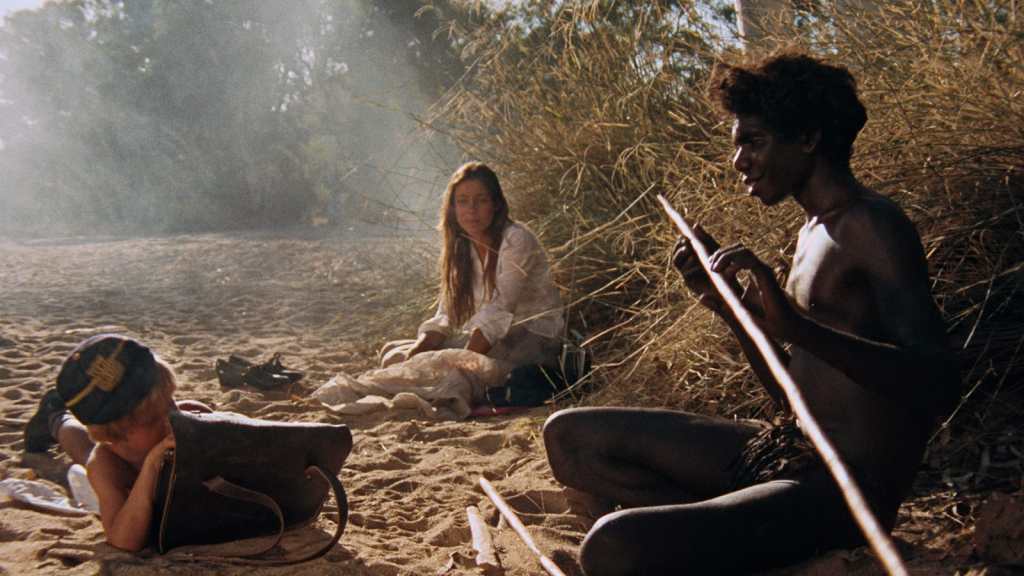
Along the way they come across the aforementioned Indigenous teen (Gulpilil himself was Yolnu, or Yolngu) performing an eponymous “walkabout.” This is a rite of passage by which Aboriginal teenagers are tasked with living along off the land alone before they are considered adults by their peers. Contrasting cultures and unable to communicate in their respective languages, the trio nevertheless form a unique bond as they traverse the countryside.
Cross-Culture Conundrum
As hinted at in the opening paragraph, Walkabout proved an entirely captivating and different experience. I’ve written before about the importance of expanding one’s horizons with respect to film consumption. This picture, however, took that to a new level and struck me in ways I couldn’t have anticipated.
Roeg’s movie is based on a 1959 novel of the same name written by James Vance Marshall. Having not read the source material, comparisons shall be avoided, although cursory research suggests that much of the plot differs. To that point, one of the major changes from novel to screenplay is the siblings’ nationality. They are American in the book, whereas the film depicts them as English expats living in Australia.
While the decision to opt for English protagonists may have something to do with the filmmaker’s nationality, it adds a special dimension to the story. At one time England was a dominant colonizing force around the globe. The existence of the Commonwealth is part of that legacy, and Australia is a Commonwealth nation. Therefore, having two quite immature youths from the former empire, accustomed to urban comforts, forced to communicate and rely on a Yolngu Aboriginal for survival makes for an arresting example of cross-cultural bonding.
The film wisely sidesteps obvious “fish out of water” plot points. The two sides do not fear each other. They don’t even display an inkling of dislike or mistrust towards the other. Rather, curiosity, a degree of openness, and dose of respect is demonstrated. Nonetheless, communication remains an issue, and their respective cultures could not be more different, so it isn’t as if everything goes smoothly.
Communication, exploration, and curiosity are key for the remainder of the movie. Although the girl never succeeds in getting her ideas across to their Aboriginal sherpa efficiently, her younger brother does. He and the local accomplish this through primitive sign and bodily language. From a certain perspective there is an irony to the fact that two characters from different age groups establish communication channels as opposed to the two teenagers. What’s more, the teens are one boy and one girl. Is this Walkabout’s way of alluding to the awkwardness when sexually maturing (but not fully mature) humans meet? Possibly, but what a way to go about it given the context.
Roeg’s Road
The name Nicolas Roeg rang a bell, but it was only upon reading up on the man and his oeuvre that things clicked. Walkabout is not the first of his projects I’ve seen. The Brit gave the world one of the most haunting, avant-gardist horror movies ever in Don’t Look Now. That’s two films of his that will probably stay with me forever, even in the offchance that I never view again. Another of his lauded pictures – albeit one I have yet to view – is The Man Who Fell to Earth, in which pop culture icon David Bowie plays an alien. Colour me curious.
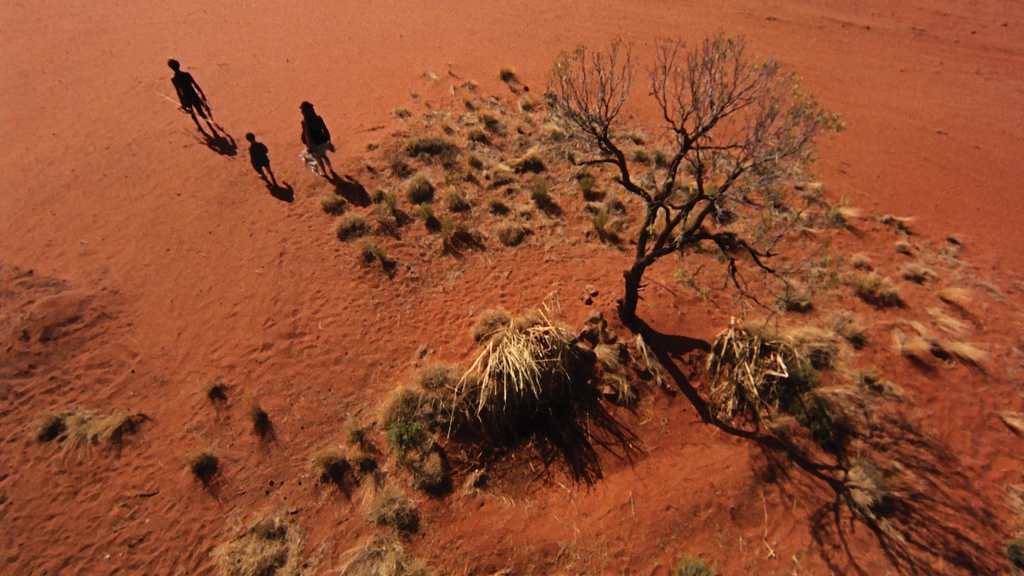
Roeg, who also served as director of photography, worked on this 1971 endeavour with editors Antony Gibbs and Lan Pattillo. It ends up being a powerhouse trio. Not only does the film look stunning in all its harshness, but the editing is exquisite insofar as it relates the notion of worlds apart existing in a shared space.
Walkabout opens and concludes with scenes in the big city, depicting the hustle and bustle of urban life. One would think there is no Australian outback. Yet there is, and it isn’t even that far away. What’s more, as per a 2021 census, there are close to one million Aboriginal Australians. The reality is that the two major cultures, Aboriginal (in all its nuances) and Westernized urban, live side by side. Roeg’s picture is, some capacity, about what happens when the stars ordain that they shall spend some time together.
Do they fully understand each other? Not really. Are they hostile? Neither. The human connection is stronger than any difference that sets people apart, yet that doesn’t mean there is a perfect comfort level under any all circumstances when cultures contact each other.
One for the History Books
My personal journey into world cinema continues. The trek through the decades, continents, and languages is a gloriously never-ending personal endeavour. Walkabout will remain in my memory and imagination for years to come.
Just as modern Australian society must handle its relations with the Aboriginals, so too does modern Canadian society with the First Nations. The two situations are not so different. Perhaps that is one of the reasons why the film attracted me so much. On a subconscious level I was watching a story that spoke about Canada, albeit from the other side of the planet.
Hmm, there’s that notion about human connections again.


Leave a Reply